Signals of governance strain in distributed brands
Table of Contents:
- Robb Fahrion – GBP posts became a CMS-scale operation
- Andy Carr – Profile categories need ongoing per-location management
- Amit Raj – Local link building doesn’t scale across markets
- Karina Karn – Centralized frameworks ignore local market realities
- David Hoos – Centralized review responses erode local relevance
- Jahnavi Ray – Regional autonomy triggers internal keyword cannibalization
- Jeff Wallace – Schema work exposed fragmented address data
- Duy Nguyen – Decentralized data destroys cross-region performance comparability
- Douglas Gargaro – Early subdomain choices create costly migrations
- Filipe Castro Matos – Visibility scales faster than operational readiness
- Tony White – Growth targets override franchisee selection discipline
- Governance Self Assessment
- Infographic
What Starts to Surface at Scale
Operator perspectives on where distributed growth first starts to break down.
 Scale rarely creates new complexity. It exposes it.
More often, it reveals where decision systems were never designed for comparability, discipline, alignment, or data consistency.
In distributed multi-location organizations, governance is rarely where the problem first becomes visible.
It usually starts with something practical: a content workflow that becomes difficult to manage, a profile setup that no longer behaves consistently across locations, a local link-building approach that works in one market but breaks in five, or location data with no standardized source of truth.
Teams compensate with extra effort, manual fixes, and temporary workarounds.
But at scale, the problem stops behaving like a local issue.
Marketing starts moving faster than operations.
Regional autonomy makes comparability harder.
Central teams push for consistency while local teams push for relevance.
The issue is not workload. It is alignment.
And increasingly, the problem is not just team alignment, but data alignment.
Scale exposes what teams were holding together informally. At some point, that stops being enough.
Increasingly, this pressure surfaces first in search systems, where distributed execution, centralized strategy, local market dynamics, and fragmented data structures collide.
Search becomes one of the earliest operating systems to reveal where coordination is already breaking.
What Looks Tactical at First
Robb Fahrion
Founder, Flying V Group
Working with leadership at a 14-location brand, Robb Fahrion shows how local content becomes a systems problem once it has to scale.
“One local search decision we made for our client BLISS Car Wash seemed simple at first but became unexpectedly complex as we scaled: content creation for Google Business Profile posts and other local listing aggregators.
Keeping BLISS’s local car wash profiles active with new, location-specific content and posts is just as important as maintaining the core profile information. As with SEO more broadly, regularly updating local profile content adds keyword-rich signals and shows search engines that the profile is active.
The real challenge came from scale. We had to ensure quality control at the location level and eventually build a system capable of distributing local business posts frequently and consistently across multiple locations.
Since BLISS locations offer different services and features, our team also had to be extremely precise with messaging, making sure that specific offers were only promoted where they actually applied.
We worked directly with the Vice President and Marketing Director to coordinate content creation at scale across both written and visual assets.
In practice, we ended up building what was essentially a CMS for BLISS’s local business posts. That effort ultimately led to significant increases in key GBP metrics, including calls, direction requests, and website visits.”
Andy Carr
Full Stack eCommerce Manager
Revco Lighting & Electrical Supply
Andy Carr points to a common shift in multi-location brands: profile decisions stop being static once different branches start serving different customer realities.
“At first, choosing a Google Business Profile category seemed simple. Then we scaled.
Primary and secondary categories started behaving differently by location, and even small profile changes began to have outsized impact. What originally looked like a static setup quickly became something we now have to manage and revisit regularly.
That reflects the structure of Revco Lighting & Electrical Supply, a regional electrical distributor with several branch locations.
Each branch serves a different mix of customers. One location, for example, includes a walk-in lighting showroom for homeowners alongside a large contractor warehouse and counter, while others are more commercially focused with no showroom, or are designed for contractors to browse aisles directly.
Keeping Google Business Profiles accurate across those differences requires ongoing attention. Categories, attributes, photos, and descriptions all need to reflect how each branch actually operates.
It’s definitely not a set-it-and-forget-it system, especially as customer mix and branch focus evolve over time.”
Amit Raj
Founder & CEO
The Links Guy
Amit Raj makes the operational limit clear: local link building may work as a relationship-driven tactic early on, but it becomes much harder to sustain across multiple markets.
“One local search decision that felt simple at first but became unexpectedly complex was scaling local link building for a US-based wedding platform operating across every city in California, with plans to expand nationally.
At a smaller, relationship-driven level, reciprocal promotions with local wedding vendors worked well. But once the model expanded across multiple cities and adjacent sectors, response rates dropped, skepticism increased, and execution became inconsistent.
While local link acquisition works well inside tightly connected communities, scaling it across regions requires significantly more resources, higher-touch coordination, or creative assets that attract links passively.
The brand centrally governs visibility, which makes strategic alignment possible, but operational scale remains the real constraint.”
Taken together, these examples point to the same thing.
At early stages of scale, the friction usually appears operational: content workflows become harder to manage, profile categories require closer oversight, and local link models start to weaken across markets.
What looks like execution trouble is often a structural problem in disguise. As distributed inputs increase, they begin to exceed the structure designed to manage them.
Decisions that once felt tactical gradually evolve into system-level issues requiring coordination, shared rules, and governance across locations
This is the point where isolated tactics stop working and governance starts to matter.
Where Alignment Starts to Strain
Karina Karn
Fractional CMO | Behavioural Science
Karina Karn frames the tension clearly: centralized efficiency starts to break down when it collides with the realities of local markets.
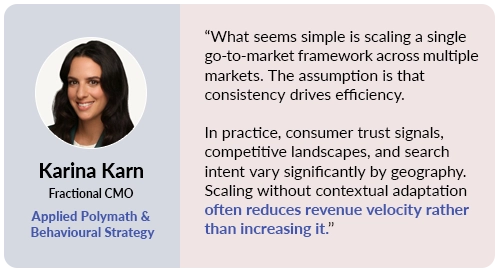
“What seems simple is scaling a single go-to-market framework across multiple markets. The assumption is that consistency drives efficiency.
In practice, consumer trust signals, competitive landscapes, and search intent vary significantly by geography. Scaling without contextual adaptation often reduces revenue velocity rather than increasing it.
This pattern appears most clearly in multi-location and franchise environments, where central teams push for standardization under the assumption that operational consistency leads to performance consistency.
Once expansion reaches roughly three to five markets, differences in local trust signals, search intent nuances, and competitive density start affecting conversion rates and revenue velocity. That is usually the point where central efficiency begins to conflict with local effectiveness.
In most mature organizations, the final decision authority tends to sit centrally. Local teams can inform and pressure-test effectiveness, but central leadership typically prevails when trade-offs involve brand coherence, cost control, or long-term strategic alignment.
When governance structures are unclear, what looks like strategic disagreement often reflects structural ambiguity around decision ownership.”
David Hoos
Haus Advisors | Agency Growth Advisor
David Hoos focuses on a different kind of strain: centralized control can protect consistency early on, but over time it can also weaken local relevance.
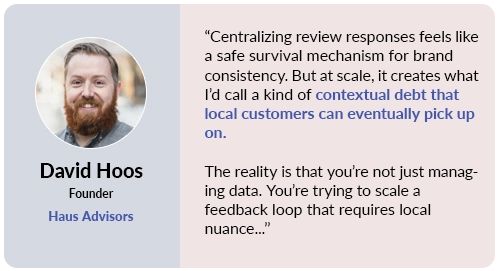
“Centralizing review responses feels like a safe survival mechanism for brand consistency. But at scale, it creates what I’d call a kind of contextual debt that local customers can eventually pick up on.
The reality is that you’re not just managing data. You’re trying to scale a feedback loop that requires local nuance, and efficiency eventually hits a wall where the brand begins to lose its relevance in the market.
In most cases, the tension stems from leadership decisions around brand control that prioritize risk reduction over local resonance.
Early on, centralizing every response is meant to prevent a ‘rogue’ manager from saying the wrong thing. But as the organization grows, that same control mechanism can start acting as an anchor on growth.”
Jahnavi Ray
Fractional CMO & GTM Architect
Jahnavi Ray brings the control issue into sharper view: regional autonomy may help early speed, but at scale it can start working against a coherent search strategy.
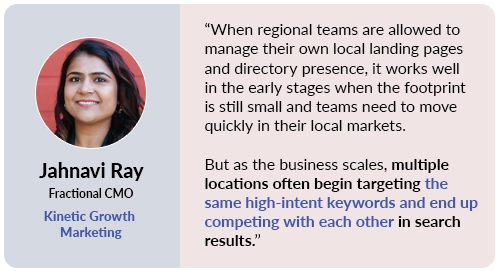
“When regional teams are allowed to manage their own local landing pages and directory presence, it works well in the early stages when the footprint is still small and teams need to move quickly in their local markets.
But as the business scales, multiple locations often begin targeting the same high-intent keywords and end up competing with each other in search results.
Different regional pages start appearing for the same buyer queries, often with slightly different messaging. This can confuse prospects and split performance across pages instead of strengthening a single, clear buyer journey.
In most cases, the most sustainable structure is one where central marketing owns search and page strategy, while regional teams focus on activating those assets locally within a shared framework.”
This same tension now shows up more clearly in AI search systems.
When content, listings, and location signals are not aligned, AI systems struggle to determine which version of a brand’s presence to trust.
At smaller scale, this inconsistency may appear as a ranking issue. At larger scale, it starts influencing which sources are cited, surfaced, or ignored in AI-generated responses.
What was previously a coordination issue becomes a question of source credibility and selection.
In this context, governance is no longer just about alignment. It determines whether the brand is treated as a credible source at all.
This is where the strain stops being only operational and becomes a question of control, credibility, and decision ownership.
Who defines the structure of visibility?
How much variation should local markets be allowed?
At what point does consistency begin to suppress local relevance?
These rarely arrive labeled as governance problems. They surface as disagreements about tactics, messaging, or local execution.
But in many multi-location organizations, what appears to be strategic disagreement is actually a deeper structural ambiguity around decision ownership.
When Informal Systems Stop Holding
Jeff Wallace
Search Engine Optimization Strategist (Ignite Visibility)
Jeff Wallace exposes a deeper data problem: what looks like a straightforward schema update can quickly uncover disorder across the entire location data ecosystem.
“What started as a simple modernization of LocalBusiness schema across 1,500+ franchise locations quickly revealed a deeper issue.
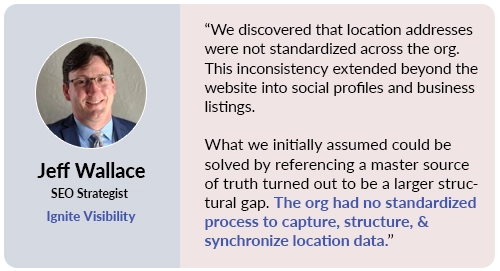
As we began structuring areaServed data using zip codes, we discovered that location addresses were not standardized across the organization.
This inconsistency extended beyond the website into social profiles and business listings. In many cases, a single franchise location had multiple variations of its address across platforms.
What we initially assumed could be resolved by referencing a master source of truth turned out to be a larger structural gap. The organization had no standardized process or system in place to capture, structure, and synchronize location data.
Before updating schema or expanding geographic targeting, we had to establish a consistent address structure across all data sources, from internal systems to external listings.
Without that foundation, any attempt to enhance visibility would have been limited, as the underlying data itself was fragmented.”
Jeff’s example points to a broader weakness in multi-location organizations.
What appears to be a technical SEO task often exposes the absence of a unified data governance model.
Without a clear source of truth, distributed data starts drifting. Once that happens, consistency, comparability, and visibility all get harder to maintain.
Duy Nguyen
Dongon | Chief Strategy Officer
Duy Nguyen describes the point at which decentralized decision-making stops helping speed and starts undermining comparability across the system.
“One decision that became unexpectedly complex was relying on decentralized local data when selecting new sites.
Early on, trusting regional managers and their on-the-ground insights felt like the most agile way to expand. Local teams understood their markets, and decisions could move quickly.
But as the organization scaled, the lack of a standardized data set made it increasingly difficult to compare performance across regions. What started as a simple local decision process eventually required a full digital transformation effort to centralize the criteria used for evaluating locations.
Each stage of scale introduces its own problems.”
When asked whether scale itself was the inflection point, Duy clarified:
“The number of locations is just a metric. The real issue was the loss of performance comparability.
That was the signal that something systemic had broken. The problem moved from ‘do more of the same’ to ‘change how we govern.’”
For Duy, scale itself was not the trigger.
The real inflection point came when performance could no longer be reliably compared across locations.
Once regional outcomes stopped being measured against a shared data framework, the system lost its ability to coordinate decisions.
What initially looked like operational complexity was actually a structural issue.
The organization no longer had a common structure for evaluating performance across locations.
At that point, the issue stopped being operational and became structural. Informal coordination was no longer sufficient.
Douglas Gargaro shifts the discussion toward architecture, showing how early platform decisions can harden into long-term structural constraints.
Douglas Gargaro
VP of SEO at QCK
One client he advises, a privately held global leader in protective coatings and spray-applied lining solutions, operates through a licensed dealer and applicator network of more than 2,000 independently owned locations across nearly 80 countries.
In distributed networks of that scale, maintaining consistent search architecture and local visibility becomes a strategic challenge.
At that scale, architecture decisions made early can lock the entire network into specific visibility constraints.
“Choosing a subdomain structure for location pages often feels clean and scalable at first. It can simplify deployments and keep different regional teams somewhat separated.
But as the brand grows, that same decision can fragment search equity and create dependency on third-party platforms or legacy systems.
If the business later decides to consolidate everything into a subfolder structure, the migration can become extremely complex.
It requires large-scale URL mapping, cross-domain tracking adjustments, structured data updates, and careful equity preservation across thousands of pages.
What initially looked like a simple architectural choice can quickly turn into a high-stakes SEO migration with real revenue implications.”
Douglas adds that these situations are not rare at scale.
“I’ve worked with many enterprise and Fortune 100 brands over the years. While I can’t share specific names, these architectural challenges appear repeatedly across multi-location businesses operating at scale.”
This is where the problem changes shape.
Scale stops being purely additive and starts exposing earlier decisions.
Earlier architectural decisions begin to compound.
Performance can no longer be compared cleanly across regions.
Systems that once worked through informal coordination now require a more formal operating structure.
The issue becomes one of governance.
Organizations move from “do more of the same” to “change how decisions are structured.”
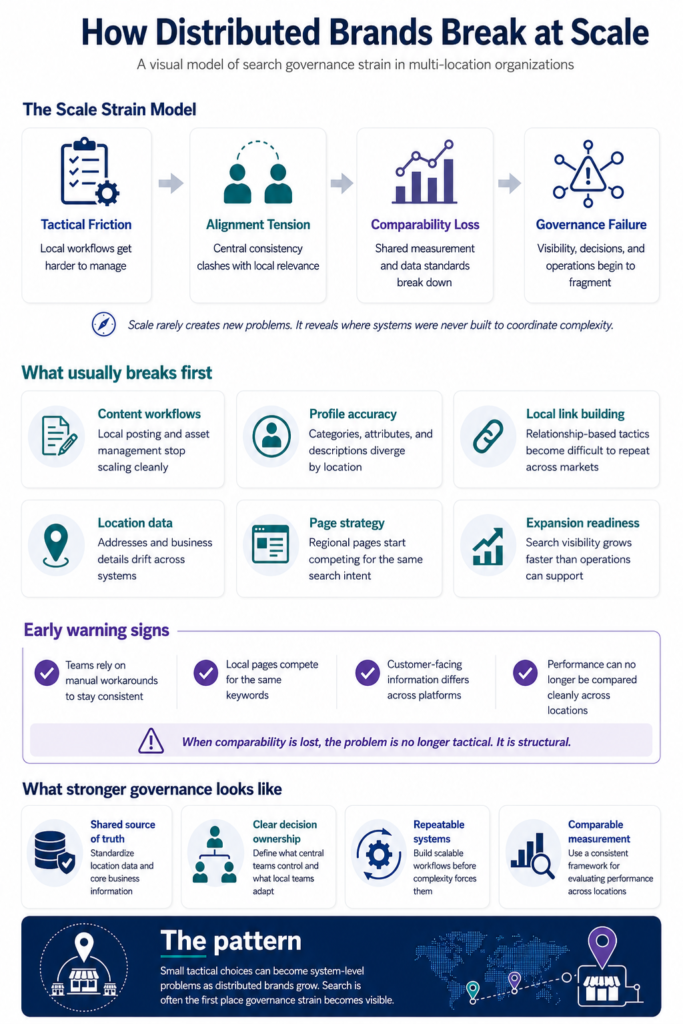
Across distributed organizations, scale tends to expose failure in four stages:
→ tactical friction
→ alignment tension
→ comparability loss
→ governance failure.
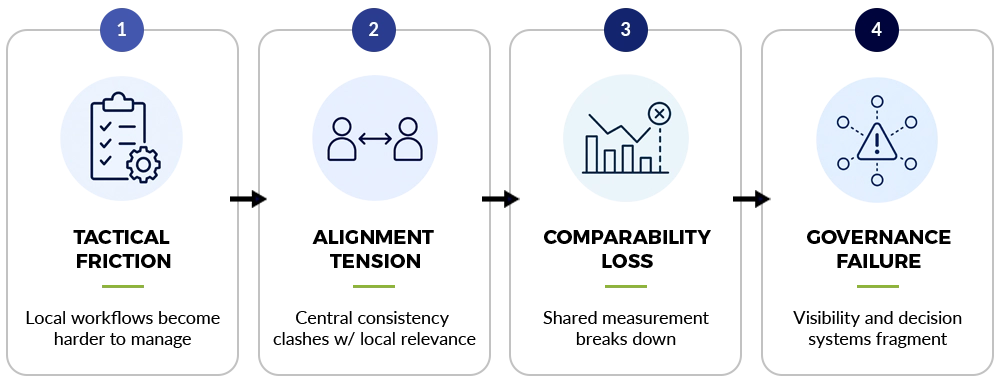
We call this progression the Search Governance Failure Model – a pattern that appears repeatedly as distributed organizations grow beyond the coordination capacity of informal systems.
What Ultimately Fractures
Filipe Castro Matos
Fractional CMO | GTM Advisor
Filipe Castro Matos shows how expansion can outpace operational readiness, especially when visibility grows faster than the business can support it.
In several growth situations he has advised on, expansion decisions were initially driven by clear demand signals.
Search volume was visible. Early traction appeared promising. Localized messaging opportunities were easy to execute.
But once expansion moved beyond the first market, operational complexity surfaced quickly.
Customer support dynamics changed.
Logistics constraints varied by region.
Delivery expectations no longer matched what the brand could reliably fulfill.
“One decision that looks straightforward at small scale is expanding into a new market simply because search demand is there.
With AI, localizing pages, messaging and even tone is easier than ever. Visibility can scale very quickly.
But support workflows, logistics, returns, delivery systems, and local expectations do not scale at the same speed.
The first symptom is rarely rankings. It’s negative reviews and support teams dealing with situations they were never prepared for.
In multi-location expansion, sequencing matters.
Local growth is often an operational decision disguised as a marketing one.”
Filipe’s example points to the same underlying problem.
Demand signals can accelerate visibility faster than organizations can align their operations.
Search visibility expands.
Customer expectations follow.
But internal processes often lag behind.
When that gap appears, the consequences surface outside the marketing function.
Negative reviews increase. Support teams become overwhelmed. Operational inconsistencies become visible to customers.
At that point, expansion stops being purely a marketing decision.
It becomes a governance decision.
Tony White
Tony White Consulting | Franchise Expansion Specialist
Tony White moves the discussion beyond marketing, showing how the earliest fractures often appear in unit economics and governance discipline first.
Having helped scale networks across more than 800 stores in 42 markets and participated in exits exceeding $180M, he notes that the earliest fractures in distributed systems rarely begin in marketing.
“Franchised unit resales become increasingly common as networks grow. Franchisors usually retain approval rights over incoming franchisees but rarely exercise them because blocking a sale slows network expansion.
High-performing operators sell their units at a premium, but incoming franchisees often enter with debt and lower operational capability. The result is declining profitability at the unit level.
Landlord fit-out contributions can also distort economics. They reduce upfront capital requirements but lock operators into higher long-term lease costs. When units change hands, the incoming operator inherits the inflated lease without receiving the original benefit.
Another common scenario appears when franchisors cannot find replacement operators. Stores temporarily move into corporate ownership, which expands operational overhead in systems designed to be franchise-led.
Refurbishment cycles also become difficult when franchisees lack the liquidity to upgrade locations, leaving the brand visually outdated.
And finally, the larger a network becomes, the harder it is to adapt quickly. Brands that resist change often lose relevance as faster competitors move ahead.”
When asked which signal tends to appear first, Tony added:
“The earliest fracture usually appears when growth targets start overriding franchisee selection criteria.
Franchisors lower capability and liquidity standards just to open more locations. That leads to weaker operators in sub-optimal sites.
Losses begin at the unit level. Franchisees start cutting corners. Customer experience deteriorates, and stores close.
Once closures begin, recruitment slows and franchisor cash flow tightens, which leads to even more compromises in operator selection. And the cycle repeats.”
Tony’s perspective reframes early scaling risk as a governance discipline issue rather than purely a marketing constraint.
In his experience, systemic fracture begins the moment growth ambition overrides capability and liquidity standards.
By the time performance dashboards reflect the damage, the structural compromise has already occurred.
At higher unit counts, the fracture is no longer primarily tactical, local-search-specific, or even marketing-driven.
It becomes structural.
Expansion sequencing, operator quality, local execution capacity, and unit economics begin to determine whether growth compounds strength or compounds fragility.
At this stage, search friction is no longer the problem itself.
It becomes one of the earliest visible signals that deeper structural strain is already underway.
What This Means for Multi-Location Brands
Across these examples, the same breakdown keeps showing up.
Multi-location search challenges rarely begin as governance issues. They usually begin as small tactical choices that do not look structural at first.
A content workflow becomes harder to manage. Profile configurations begin to vary by location. Local adaptation starts colliding with central control. Underneath all of that, location data itself may no longer be standardized across systems.
But as organizations scale, these decisions start to interfere with each other.
Operational strain becomes alignment tension.
Alignment tension becomes comparability loss.
Comparability breaks down faster when the organization lacks a consistent source of truth across its core data systems.
And eventually, those architectural choices begin locking organizations into specific operating models.
At that stage, the question is no longer how to execute local search, but how visibility itself is governed across the organization.
What Becomes Clear
If search environments surface early governance signals, the question is no longer how to improve rankings..
Scale does not create new problems. It reveals whether decision systems were built to absorb distributed complexity without fragmenting performance across locations.
This goes beyond workflows, ownership, and decision rights. It also depends on the integrity and consistency of the data those systems rely on.
Across distributed organizations, search systems often become the first operating layer where governance failure becomes visible, not because search is unique, but because it sits at the intersection of marketing execution, local operations, centralized strategy, and structured business data.
This is what we mean by Search Governance for Distributed Brands.
Steve Wiideman works with leadership teams to map structural search governance pressure before it turns into wider performance and economic damage.
Governance Self Assessment
A Quick Self Diagnosis

Contributors
Robb Fahrion
Founder, Flying V Group
LinkedIn: https://www.linkedin.com/in/robbfahrion/
Andy Carr
Full Stack eCommerce Manager
Revco Lighting & Electrical Supply
LinkedIn: https://www.linkedin.com/in/andrewlcarrny/
Amit Raj
Founder & CEO, The Links Guy
LinkedIn: https://www.linkedin.com/in/link-building-expert/
Karina Karn
Fractional CMO | Applied Polymath | Behavioural Strategy
LinkedIn: https://www.linkedin.com/in/karinakarn/
David Hoos
Agency Growth Advisor (www.hausadvisors.com)
LinkedIn: https://www.linkedin.com/in/davidhoos/
Jahnavi Ray
Fractional CMO & GTM Architect
LinkedIn: https://www.linkedin.com/in/jahnaviray/
Jeff Wallace
Search Engine Optimization Strategist (Ignite Visibility)
LinkedIn: https://www.linkedin.com/in/jeffmwallace/
Duy Nguyen
Chief Strategy Officer | Digital Transformation & Distributed Operations
LinkedIn: https://www.linkedin.com/in/duynh/
Douglas Gargaro
VP of SEO at QCK (https://qck.co/)
LinkedIn: https://www.linkedin.com/in/dou9las/
Filipe Castro Matos
Fractional CMO & GTM Advisor
LinkedIn: https://www.linkedin.com/in/filipecastromatos/
Tony White
Franchise Expansion Specialist
LinkedIn: https://www.linkedin.com/in/tonywhite26/
Governance Infographic